 LinkClerk
18 February 2026
LinkClerk
18 February 2026
Most conversations about SEO eventually circle back to links. We’re talking both internal links and external links. These links shape how search engines understand your website, how users move through your content and how your authority grows over time.
Internal links and external links each play a different role in that process, and when you use them well, they can lift your rankings in a way that feels natural and sustainable.
This guide walks through what they are, how they work and how to use them in a way that feels helpful for readers and easy for search engines to interpret.

Table of Contents
Understanding Internal Links
Internal links are the connective tissue of your website. They quietly shape how people move through your content and how search engines interpret the structure of your site. Most sites have plenty of internal links without thinking about them, but the real gains come when you use them deliberately rather than letting them form by accident.
At the simplest level, an internal link is any link that points from one page on your site to another. That includes the obvious things like your main navigation and footer, but the real power sits in the links you place inside your content.
These contextual links help readers dive deeper into a topic, discover related ideas and stay engaged for longer. They also help search engines understand which pages belong together and which ones carry the most weight.
Different types of internal links play different roles. Navigation links set the overall structure and help people find the major sections of your site. They’re predictable and stable, which makes them useful for both users and crawlers.
Contextual links are more flexible. They appear inside your articles, guides or product pages and point to something relevant. These links carry strong semantic signals because they sit inside meaningful text.
Breadcrumbs help people understand where they are in a hierarchy and give them a quick way to jump back. Footer links often reinforce your most important pages or categories.
When internal links are used with intent, they do more than guide people around. They help search engines recognise which pages are central to your expertise.
Effortless backlink management
Audit, organise, and upgrade your links in minutes; not hours. We manage and monitor every backlink to improve your SEO and stay up to date.
If you consistently link to a particular guide, category or service page, you’re signalling that it deserves attention. This is one of the simplest ways to strengthen the visibility of commercial pages without stuffing keywords or forcing awkward copy.
Internal links also help you avoid orphan pages. These are pages that exist on your site but aren’t linked to from anywhere meaningful. Search engines struggle to find them, and users never stumble across them naturally. A quick internal linking pass can bring these pages back into the fold and give them a chance to rank.
Another overlooked benefit is how internal links help revive older content. When you publish something new, linking back to relevant older articles can breathe life into them. Search engines see fresh signals pointing to those pages, which can help them regain traction.
The best internal linking feels invisible. It doesn’t interrupt the reading experience or feel like a tactic. It simply helps people find what they need and helps search engines understand the shape of your site.
When you treat internal linking as part of your publishing workflow rather than a chore you do once a year, your site becomes easier to navigate, easier to crawl and far more coherent as a whole.
Understanding External Links
External links are the bridges that connect your content to the wider web. They point from your site to another website and help readers explore ideas, verify information and access resources you don’t host yourself. While internal links help you shape your own ecosystem, external links show that your content sits within a broader conversation.
At their core, external links are about credibility. When you reference a reputable study, a government source or a respected industry publication, you’re signalling that your content is grounded in something real. Readers appreciate it because it helps them trust what you’re saying. Search engines appreciate it because it helps them understand the context and reliability of your information.
There are a few different types of external links, each with its own purpose like natural link building and user generated content. Editorial links are the most natural. They appear when you cite a source or reference something genuinely useful. Resource links point readers to tools, guides or data that add value to your topic.
Affiliate links are commercial and need to be labelled correctly so readers and search engines understand the relationship. Sponsored and UGC links help clarify whether the link was paid for or created by a user rather than an editor.
The quality of the sites you link to matters. Linking to reputable sources strengthens your content. Linking to low quality or spammy sites can do the opposite.
It’s worth taking a moment to check whether the site is trustworthy, whether the information is current and whether it genuinely helps the reader. A well‑chosen external link can elevate your content. A careless one can weaken it.
External links also play a role in how search engines interpret your expertise. When you consistently reference high quality sources, you’re showing that you understand your topic and that you’re willing to back up your claims. This is especially important for topics that involve data, health, finance or anything where accuracy matters. It’s not about quantity. It’s about choosing sources that add clarity and depth.
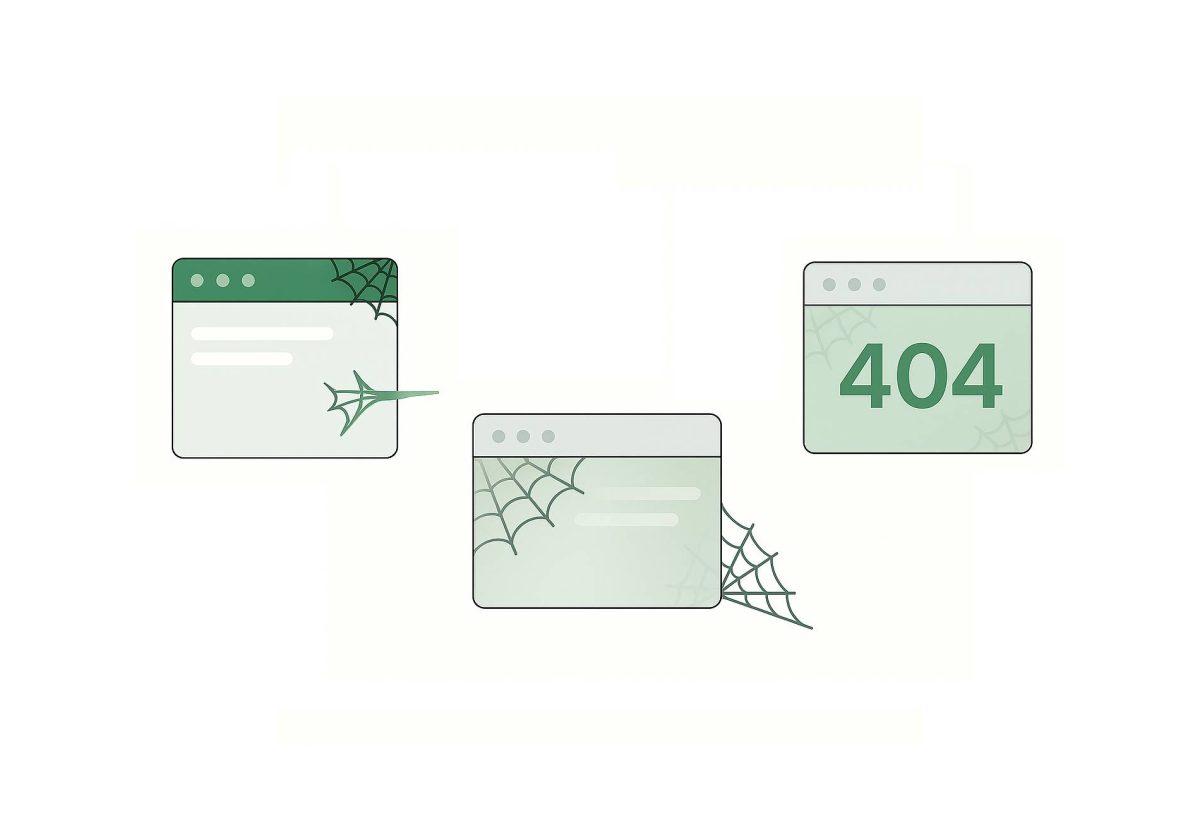
There’s also a practical side to managing external links. Over time, sites change, pages move and URLs break. A link that worked last year might lead to a 404 today. Regular link checks help you keep your content fresh and avoid frustrating your readers. It’s a small maintenance task that pays off in trust and usability.
Used well, external links make your content feel more grounded and more generous. They show that you’re part of a wider community of information rather than trying to keep readers boxed in. When you link out with intent, you create a better experience for your audience and a clearer signal for search engines.
Internal Links and External Links Compared
Internal links help you shape your own site structure. External links help you show that your content is grounded in credible information. Internal links keep people engaged with your content. External links help you build trust by pointing to reliable sources.
Both matter. Both influence how search engines interpret your content. And both contribute to a better experience for your readers.
How Internal Links Improve SEO
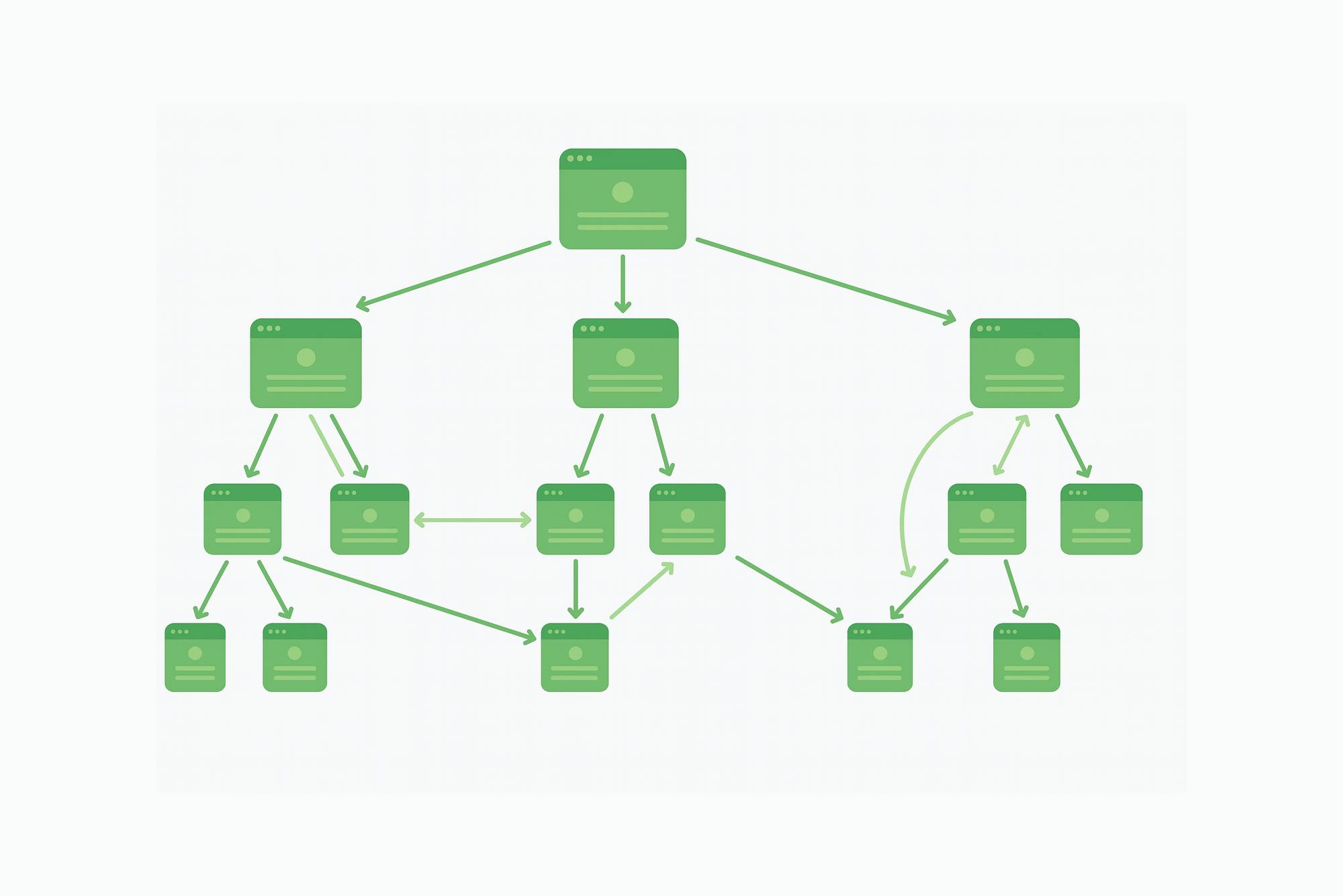
Internal links are one of the simplest ways to strengthen your SEO without creating new content. They help distribute authority across your site, especially when you link from strong pages to those that need a lift.
They also help search engines crawl your site more efficiently, which is essential if you publish regularly or have a large archive.
Topic clusters help you group related content around a central hub.
A strong internal linking approach usually includes a few key ideas. Topic clusters help you group related content around a central hub. Supporting pages can pass authority to commercial pages without feeling forced.
Older content can be revived by adding new internal links that point to it from fresh articles. Regular internal link audits help you spot gaps, broken links and orphan pages.
When you treat internal linking as part of your publishing workflow rather than an afterthought, your site becomes easier to navigate and easier for search engines to understand.
How External Links Improve SEO
External links prove to Google and other search engines that your content is connected to the broader web. When you link to reputable sources, you strengthen your credibility and help readers verify what you are saying. This is especially important for topics that involve data, research or expert opinion.
There is a practical side to this as well. Linking to low quality or spammy sites can harm your reputation. Linking to commercial partners without the correct attributes can create compliance issues. Linking to outdated or unreliable information can weaken your content.
A simple checklist helps. Ask whether the source is reputable, whether it adds value and whether it is still current. If the answer is yes, it is usually safe to include.
Finding the Right Balance Between Internal and External Links
There is no magic ratio. The right balance depends on the type of content you are creating. A long form guide might naturally include more internal links because you have more related content to reference. A research heavy article might include more external links because you are citing data.
A practical way to think about it is this. Internal links help readers go deeper into your world. External links help them understand the world around your topic. If both feel natural and useful, you are on the right track.
Making Anchor Text Work Harder
Anchor text is one of those small details that quietly carries a lot of weight. It’s the visible text you click on, but it also tells readers what to expect and gives search engines clues about the relationship between the two pages. When it’s written well, it feels effortless. When it’s written poorly, it sticks out like a sore thumb.
A lot of sites fall into the trap of treating anchor text as a place to cram keywords. That might have worked a decade ago, but today it just makes your writing feel stiff and unnatural. Search engines are far better at understanding context now, so the goal isn’t to force exact match phrases. It’s to write anchor text that feels like something a real person would naturally use in a sentence.
There are a few different styles of anchor text, and each has its place. Exact match anchors can be useful when they genuinely fit the sentence, but they lose their power when you repeat them too often. Partial match anchors give you more flexibility and usually sound more natural. Branded anchors work well when you’re linking to tools, companies or research. Then there are the purely descriptive anchors that simply explain what the reader will find on the other side. These are often the most user friendly because they set clear expectations.
The real art is choosing anchor text that blends into the writing without losing clarity. If the link interrupts the flow of the sentence, it’s probably the wrong anchor. If it feels like something you’d say out loud, you’re on the right track. A good test is to read the sentence without the link. If it still makes sense and still feels natural, the anchor text is doing its job.
Anchor text also plays a role in how search engines understand your site structure. When you consistently use clear, relevant anchors, you help search engines recognise which topics belong together and which pages carry the most authority. This is especially important when you’re building out topic clusters or supporting commercial pages with informational content.
There’s also value in mixing up your anchors. Using the same phrase every time you link to a page can look unnatural, even if the phrase is technically accurate. Varying your anchors helps your writing feel more human and gives search engines a broader understanding of how people might refer to that topic.
At the end of the day, anchor text is about clarity and usefulness. It should help readers understand where they’re going and help search engines understand why the link matters. When you treat it as part of your writing craft rather than a technical chore, it becomes one of the simplest ways to strengthen your content without drawing attention to itself.
How AI Search Interprets Links
AI‑driven search has changed the way links are understood. Traditional search engines relied heavily on crawling, indexing and PageRank signals. Those still matter, but modern search systems now use large language models to interpret meaning, relationships and intent. This shift has made internal and external links even more important, because they help AI understand not just what your content says, but how it all fits together.
Internal links give AI a clearer picture of your site’s structure. When you consistently link related pages, you’re effectively drawing a map of your expertise. AI models use these patterns to recognise which topics you cover in depth, which pages act as hubs and which ones support them. This is especially useful when you’re building topical authority. A well‑linked cluster of articles tells AI that you’re not just touching on a subject, you’re covering it thoroughly.
Context also matters. AI doesn’t just look at the link itself. It looks at the surrounding text, the section it appears in and the broader theme of the page.
Try LinkClerk for free
Weekly backlink audits without the manual work. Try a free trial today!
This means your internal links carry semantic weight. They help AI understand how ideas connect, which concepts belong together and which pages deserve more visibility. It’s a more nuanced interpretation than the old “link juice” model, and it rewards sites that link with purpose rather than volume.
External links play a different role. They help AI verify the accuracy and reliability of your content. When you reference reputable sources, you’re giving AI a way to cross‑check your claims. This is especially important for topics where factual accuracy matters, such as finance, health, legal information or anything involving data. AI models are trained to look for signals of trust, and high‑quality external links are one of the clearest signals you can provide.
There’s also a behavioural angle. AI‑driven search systems pay attention to how people interact with content. If readers follow your external links, spend time on the referenced pages and return to your site, that behaviour reinforces the idea that your content is useful and well‑supported. It’s a subtle feedback loop, but it contributes to the overall picture of quality.
Another shift is how AI handles ambiguous or broad queries. Instead of relying solely on keywords, AI looks for patterns of meaning. Internal links help it understand which pages are central to a topic and which ones offer supporting detail. External links help it understand where your information sits within the broader landscape. Together, they help AI decide whether your content is a good match for a user’s intent.
All of this means linking is no longer just a technical SEO task. It’s part of how you communicate meaning to AI. When your internal links form a clear, logical structure and your external links point to credible sources, you’re giving AI everything it needs to understand your content at a deeper level. It’s a quiet advantage, but a powerful one.
Common Mistakes to Avoid
A few link building mistakes come up again and again. Overusing exact match anchors can make your content feel unnatural. Linking to irrelevant pages can confuse readers.
Linking to low quality external sites can damage your credibility. Leaving orphan pages untouched can limit your visibility. Broken links can frustrate readers and weaken trust.
Most of these issues are easy to fix once you know they are there.
Final Thoughts
Internal links and external links might seem like small details in the bigger picture of SEO, but they’re often the difference between a site that quietly performs and a site that steadily grows in visibility, trust and usefulness.
They shape how people move through your content, how search engines interpret your expertise and how AI models understand the relationships between your ideas. When you treat linking as part of your craft rather than a technical chore, your content becomes clearer, more connected and far more valuable.
A balanced linking approach doesn’t need to be complicated. It simply needs to be intentional. Internal links help readers explore your world and help search engines recognise the depth of your knowledge. External links show that you’re willing to reference credible information and contribute to the broader conversation. Together, they create a richer experience for your audience and a stronger foundation for your site.
The most effective linking strategies are the ones that feel natural. They don’t interrupt the flow of your writing or draw attention to themselves. They quietly guide readers, support your ideas and help search engines make sense of your structure. When you build linking into your writing process, it becomes second nature. You start spotting opportunities as you draft, update and refine your content.
In the end, good linking is really about respect. Respect for your readers, who deserve clarity and helpful pathways. Respect for your content, which deserves to be understood in context.
And respect for the search engines and AI systems that are trying to interpret your work as accurately as possible. When you link with purpose, you’re not just improving your SEO. You’re building a site that feels thoughtful, trustworthy and genuinely useful.